
Parker Solar Probe

When Parker solar probe was achieving a breakthrough of the largest of its kind, we had to communicate the importance of what Parker was doing on the frontiers of the largest star in our solar system; So we are here to take you on a journey inside Parker solar probe's Cinema

What Is Parker Solar Probe?
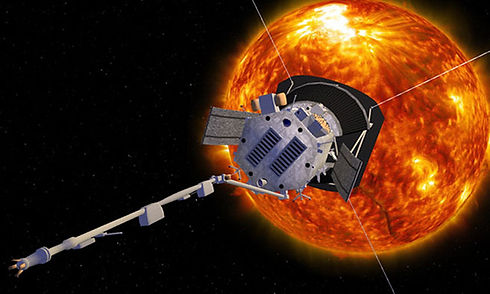
For the first time in history, a NASA’s Parker Solar Probe has now flown through the Sun’s upper atmosphere – the corona –.
Parker Solar Probe launched in 2018. Three years after launch and decades after first conception, Parker has finally arrived.
Unlike Earth, the Sun doesn’t have a solid surface. But it does have a superheated atmosphere, made of solar material bound to the Sun by gravity and magnetic forces. As rising heat and pressure push that material away from the Sun, it reaches a point where gravity and magnetic fields are too weak to contain it.
That point, known as the Alfvén critical surface, marks the end of the solar atmosphere and beginning of the solar wind. Solar material with the energy to make it across that boundary becomes the solar wind, which drags the magnetic field of the Sun with it as it races across the solar system, to Earth and beyond. Importantly, beyond the Alfvén critical surface, the solar wind moves so fast that waves within the wind cannot ever travel fast enough to make it back to the Sun – severing their connected Alfvén critical surface lay. Based on remote images of the corona, estimates had put it somewhere between 10 to 20 solar radii from the surface of the Sun – 4.3 to 8.6 million miles. Parker’s spiral trajectory brings it slowly closer to the Sun and during the last few passes, the spacecraft was consistently below 20 solar radii (91 percent of Earth’s distance from the Sun), putting it in the position to cross the boundary.
On April 28, 2021, during its eighth flyby of the Sun, Parker Solar Probe encountered the specific magnetic and particle conditions at 18.8 solar radii (around 8.1 million miles) above the solar surface that told scientists it had crossed the Alfvén critical surface for the first time and finally entered the solar atmosphere.
During the flyby, Parker Solar Probe passed into and out of the corona several times. This is proved what some had predicted – that the Alfvén critical surface isn’t shaped like a smooth ball.


LET'S START!
"Not only do we want to reach for the stars, but also we want to Touch The Sun."
